
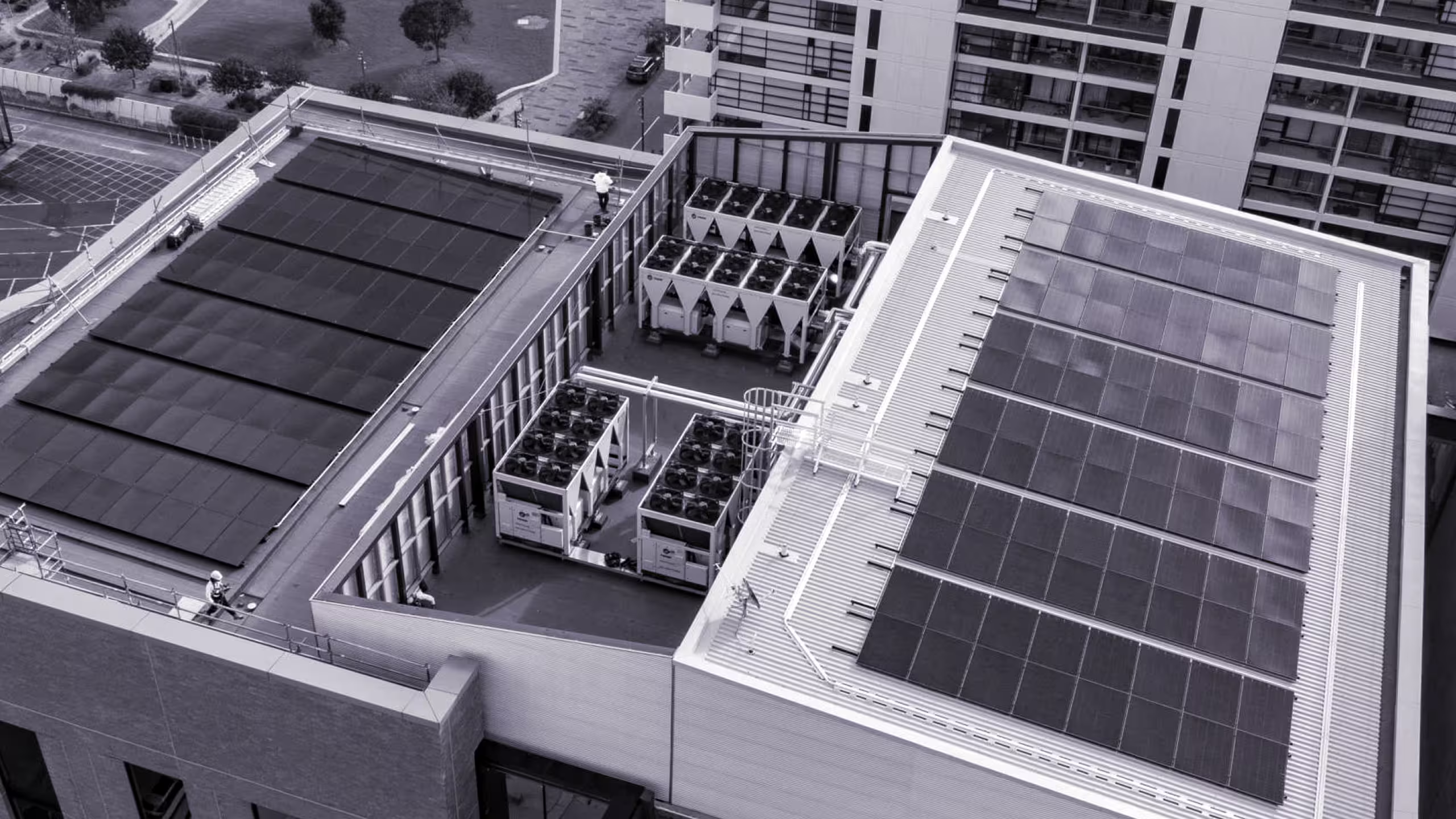
For many Auckland businesses, yes, particularly those that use most of their power during the day. But it depends on your usage pattern, roof space and current power costs, not a blanket rule. Here’s how to work out whether the numbers genuinely stack up for your business, including when they might not.
This isn’t a niche technology for businesses either. In Australia, rooftop solar now generates more electricity nationally than every coal-fired power station combined, a clear sign of how far solar has moved from alternative energy to mainstream business infrastructure.
Rates and terms change regularly, so figures aren’t quoted in this article. Always confirm current details directly with your bank.
Solar panels generate power during daylight hours. If your business consumes most of its electricity during that same window, running equipment, lighting, refrigeration or HVAC through the working day, you’re using your own generated power directly, which is where the strongest financial case comes from. If your business’s biggest power draw happens after hours, the picture changes significantly.
Warehouses and industrial sites, particularly those running equipment, refrigeration or ventilation throughout the working day
Retail premises, where fridges, lighting and air conditioning run consistently during trading hours
Offices with high daytime occupancy, where computers, lighting and climate control are the main draw
Manufacturing and production sites, where machinery runs on a consistent daytime schedule
Hospitality businesses that trade mainly in the evening, such as bars and restaurants with limited daytime power use
Businesses with very low daytime consumption, where there simply isn’t much load for solar to offset
Properties with limited or heavily shaded roof space, which restricts how much system you can realistically install
This isn’t a reason to rule solar out automatically, a battery can shift some of this equation, but it does mean the numbers need a proper look rather than an assumption either way.
Several factors interact to determine how quickly a commercial solar system pays for itself:
1. System size relative to your usage.
An oversized system relative to your daytime load exports more power back to the grid at a lower return than it would if used directly.
2. Roof orientation and shading.
Even a well-placed system underperforms if it’s partially shaded for large parts of the day.
3. Your current power cost structure.
Businesses on higher commercial rates typically see a stronger case than those on already low rates.
4. Whether a battery is added.
This changes the payback calculation, since it lets you use more of your generated power outside daylight hours, at an additional upfront cost.
Financial payback isn’t always the only consideration. Some businesses factor in:
Price certainty.
Generating your own power provides some insulation against future power price rises.
Sustainability reporting.
Increasingly, businesses face pressure from customers, investors or head office to demonstrate genuine energy decisions, not just marketing claims.
Tenant attraction.
For landlords, solar can be part of what makes a commercial property more attractive to prospective tenants.
Planning for EV fleet transition.
If your business is moving toward electric vehicles, solar and EV charging planned together can make both investments work harder.
The honest answer is that no generic calculator, including a quick online estimate, can give you a reliable answer without your actual usage data, roof details and switchboard capacity. That’s exactly what a proper commercial solar review is for, it’s the only way to move from “solar generally makes sense for businesses like mine” to “here’s what it would actually do for my property.”
Not ready for a full review? Have a no-obligation, 15-minute chat with a Solar Electrician and get your questions answered first.



0800 ASTECH
(0800 278 324)
09 634 3220
Astech Electrical,
189 Captain Springs Road,
Auckland 1061
© Astech Electrical 2026